Equally passionate about global education and STEM education, I was interested in answering the following guiding questions:
- What does STEM education look like in Morocco?
- What role does STEM education play in addressing global challenges such as climate change?
- How have agricultural practices (traditional small-scale and large-scale farms) been influenced by climate change and modernization? What is the Moroccan diet profile?
Guiding Questions Reflection Part I
- What does STEM education look like in Morocco?
- What role does STEM education play in addressing global challenges such as climate change?
Education and Language
There are challenges in science education in Morocco as a former protectorate of France. Even though independence from France occurred in 1956 much still needs to be done to encourage and equip students with the skills needed to pursue STEM education in high school and beyond. High school in Morocco has three grades similar to the US grades 10-12. Public schooling at the elementary level begins with Arabic. By third grade French is introduced and by ninth grade English is introduced.
In the late 1980’s teaching and learning in Arabic became more widespread and replaced the teaching of sciences in French at the public high school level. A significant challenge for Moroccan students is that the sciences with few exceptions are only taught in French at the University level! Partly because of this, there has been a rise in private schools that teach curricula in French. The cost of private schooling selects for wealthier families and puts the general public students at a disadvantage in terms of pursuing higher education in the sciences.
So, sciences are typically taught in Arabic at public high schools. Students choose to enter the math-science track or the arts track (literature, economics). Regardless of track, all students take mathematics classes but they are different for students pursuing the science track.
Biology/Geology Class Observation
I attended a combined biology/geology class and perused students notes taken for the course. The curriculum topics were similar to the NYS Regents earth science and AP Biology courses taught at Croton-Harmon HS. All content is advanced and similar to a college level course in difficulty.
The lesson I observed titled “Metamorphic Rock and their Relation to the Tectonic Plates” was taught lecture-style with a Powerpoint presentation. The teacher, who was very skilled, used a series of microscope micrographs displayed in the Powerpoint to check for understanding. He also had several rocks for demonstration. Although the science content is more advanced that US science courses, laboratory and field work are lacking due to lack of resources as opposed to curricular constraints. The class was taught in Arabic to 12th grade (Baccalaureate 2) students in their final year of high school. These students are on track for science related majors when they attend University. These students will need to be able to complete science courses at University in French even though they were taught science in Arabic. (See March 20th blog)
The Baccalaureate Exams
There is a Nationwide Bac 2 exam administered at the end of 12th grade (Baccalaureate 2) which takes 3 days to complete.
- Day 1 Physics and English
- Day 2 Math and Philosophy
- Day 3 Geology and Biology
Each exam is three hours in duration except English and philosophy which are two hours long. The score on the Baccalaureate 2 exam counts as 50% of the overall student GPA that will be submitted in university applications! Other assessments contributing to a student’s high school GPA are the Bac 1 exam taken at the end of 11th grade (25%) and teacher assessments throughout 12th grade (25%). Note that 10th grade (known as the common core year) has no impact on student grades.
Teacher Training
During our visit to Ecole Normale Supérieure (ENS) of the University Mohammed V – Rabat (secondary education teacher training department) I learned that students wishing to pursue teaching attend this one year program after they have received university degrees in the subject matter of interest.
We toured the campus and attended a Teachers for Global Classrooms Forum where we were welcomed by Imane Nejjar, Head of the Department of Foreign Languages and Cultures. Ms. Nejjar described the mission of ENS and the rationale that “ We need to be global to exchange best practices and we are teaching the hope generation.” The University has eleven departments of study including the sciences, humanities, and education. Similar to my professional experiences in the US, ENS practices espose theory, practice, and internship for teacher preparation. I participated in the forum by presenting my valuable experience as a Regeneron STEM Teacher Fellow. I described how my experience aligns with the ENS practices. For example, I took graduate level courses to strengthen best practices in STEM education, I used what I learned in my practice with my students and with fellow teachers that attended a workshop I created, and I learned about best practices in the scientific community when I conducted scientific experiments under the supervision of Regeneron Pharmaceuticals scientists.
Climate Change and STEM Education
During our visit to the University, I was fortunate to meet two 3rd yr PhD students names Bouchra and Dounia who are researching how to improve solar energy electricity generation effectiveness by designing methods to reduce or clean dirt/dust deposition on the panels. The campus has several buildings with solar panels generating about 20% of the campus energy requirements. Bouchra and Dounia were kind enough to give me a tour! (See March 14 blog)
Upon further research about the use of solar power in Morocco, I found that the government promotes the renewable energies sector with an interest in long-term export of renewable energy to Europe. An impressive national goal is to obtain 42% of energy from renewable origins by 2020, and 52% by 2030, with solar, wind and hydropower each providing a third of the total.
To aid in goal achievement and provide jobs for citizens, the Moroccan Agency for Solar Energy (MASEN) is expanding the investment in STEM training by creating institutes for solar thermal systems, solar photovoltaic systems, wind energy efficiency systems in buildings and biogas (9/14/18 news release https://www.afrik21.africa/en/morocco-masen-to-invest-e5-2-million-in-renewable-energy-training/).
I was impressed to find that Morocco is home to one of the world’s largest solar farms (The Noor Ouarzazate Project) with installed total capacity of solar power of 580 MW (The complex covers 3000 hectares or 11.5 mi2). This solar farm has the potential to provide energy to power greater than one million homes and reduce carbon emissions by an estimated 760,000 tons/yr. Two articles providing me with this information are linked here. https://www.worldbank.org/en/news/feature/2015/11/20/morocco-to-make-history-with-first-of-its-kind-solar-plant and https://www.cnn.com/2016/02/08/africa/ouarzazate-morocco-solar-plant/index.html
I also found this short video titled “Concentrating Solar Power Sparks Jobs, Technology, Investment in Morocco” enlightening. (2.39 min)
https://www.youtube.com/watch?time_continue=159&v=FlNSh1FRONw
Guiding Questions Reflection Part II
- How have agricultural practices (traditional small-scale and large-scale farms) been influenced by climate change and modernization? What is the Moroccan diet profile?
As an AP Environmental Science teacher, I was interested in conducting this research so that I can provide a case study on Moroccan agricultural practices and climate change for my students. The link below is the “Agricultural Practices in Morocco” presentation I have created. In this presentation you will find considerable detail on oasis farming and the Moroccan diet profile.
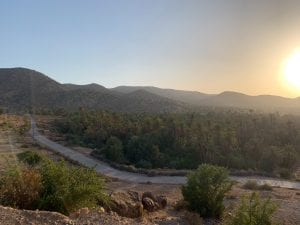
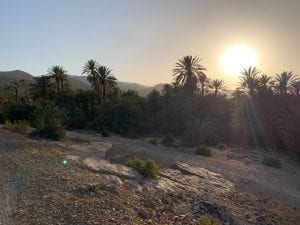
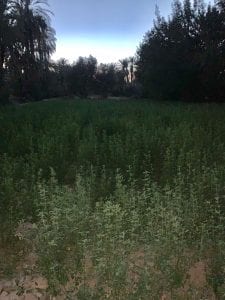
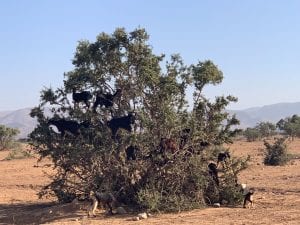
I found through research and personal experiences that traditional agriculture practices (silvopastoralism and oases), crucial for the sustenance of Moroccan people, are being threatened by modernization and global climate change. About 38% of the Moroccan population is rural and most are small-scale farmers with less than 5 ha (12 acres) of land. These small farms provide food for the farmers themselves and surplus crops may be sold at open air markets or even cooked on roadsides for sale to passersby. Silvopastoralism and oasis farming by indigenous peoples is being threatened by modernization of lifestyles, increasing monoculture farming techniques, and global climate change. The central government and municipalities of Morocco recognize the importance of preserving traditional farming practices not only for cultural reasons but also to mitigate the effects of climate change (especially drought and desertification). The The Green Moroccan Plan (2008) includes plans for sustainable agriculture production and climate change adaptation and mitigation. This link is the Green Moroccan Plan website. http://www.foodfrommorocco.ma/en/secteur-agricole/green-moroccan-plan
Anecdotally, personal experience and reports from my fellow Fulbrighters travelling to different regions of the country have indicated that medina marketplaces have abundant piles of wide varieties of fresh, unprocessed agricultural products. Our culinary experiences have been rewarding as we consumed these fresh products in traditional dishes such as the highly revered couscous and tagine meals. The “International Teen Favorite Survey 2019” created by myself and my fellow traveller, Lindsey Smaka, revealed that the 62 surveyed Moroccan teens’ favorite foods are tagine (37%), couscous (24%) whereas the 114 surveyed US teens’ favorites are more diverse with smaller percentages of students agreeing on “favorites”. Pizza and pasta made the top of the list for American students at 20 and 19% respectively. (This link has our survey results https://docs.google.com/document/d/1bNvDbrov46UzUbDzjafbsTKLkhd92bkhV3zQudU5DtE/edit#heading=h.jwn5uuwepf7x).
Our fellowship cohort also heard or witnessed first hand the following:
drought is a major concern for farmers, countryside farming was tool to hand with no large machinery seen, and the Chamber of Agriculture provides some machinery to farmers to promote productivity.














 Street Entry
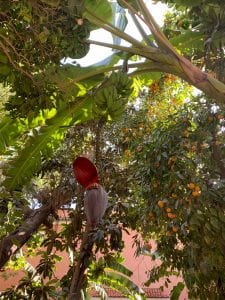
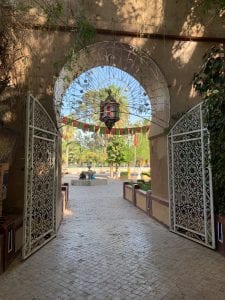
 Courtyard gardens


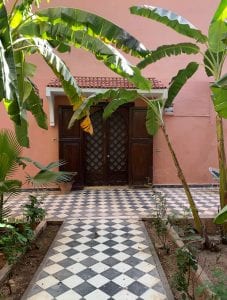 My room entry